
PFAS shows up everywhere. We meet it where it is.
The future of PFAS treatment will be defined by disposal economics. From landfill leachate to industrial reject streams, Thermobind reduces PFAS waste volume.
Landfills and Leachate
Leachate · RO retentate · FF Formate
Municipal and industrial landfills are one of the largest concentrated sources of PFAS, leachate routinely measures in the parts-per-billion to parts-per-million range, far above drinking-water limits. Hauling and incinerating that liquid is expensive, and discharging it back to a WWTP just spreads the problem.
Thermobind polymer binds PFAS in the leachate stream at ambient temperature, and a single bind–flocculate–filter cycle in the skid drops volume by over 98%. Sites get a small, stable, manifest-ready solid in place of trucks of liquid leachate, and the treated water can re-enter the site's normal discharge path.
Industrial Manufacturing
Metal plating · semiconductor · textile · specialty chemicals
Process water in metal plating, semiconductor fabs, textile coating, and specialty chemical lines accumulates PFAS that current treatment hands back as concentrated reject. Storing and disposing of that reject ties up real estate and budget.
A fixed Thermobind line installed downstream of RO or ion exchange reduced PFAS waste volume over 98%, turning monthly drums of liquid into compact solids that fit standard manifest workflows.
Water Utilities
RO reject · brine handling · compliance polishing
Utilities meeting tightening PFAS limits with RO, IX, and Foam Frac (FF) end up with concentrated reject and spent media that must go somewhere. Volume-to-disposal is the silent cost driver in PFAS compliance.
Thermobind sits downstream of polishing systems, converting reject streams into compact solids, slashing PFAS waste leaving the plant by orders of magnitude.
Environmental Services
On-site remediation · brownfield cleanup · spill response
Remediation contractors deliver capture but inherit the disposal problem. Trucking thousands of gallons of liquid concentrate across state lines is slow, expensive, and high-risk.
A portable Thermobind skid drops onto the job site, processes reject in place via continuous flow, and produces a single, transport-ready solid, collapsing project logistics and improving margin.
Incineration Pre-Treatment
Volume reduction before thermal destruction
Specialty thermal destruction facilities work, but cost, scarcity, and high-temperature operation make them a poor fit for moving large volumes of dilute waste.
Thermobind serves as a high-leverage pre-treatment: reduce input feed volume by over 98% so the downstream thermal step is reserved for the small, dense, bound floc only.
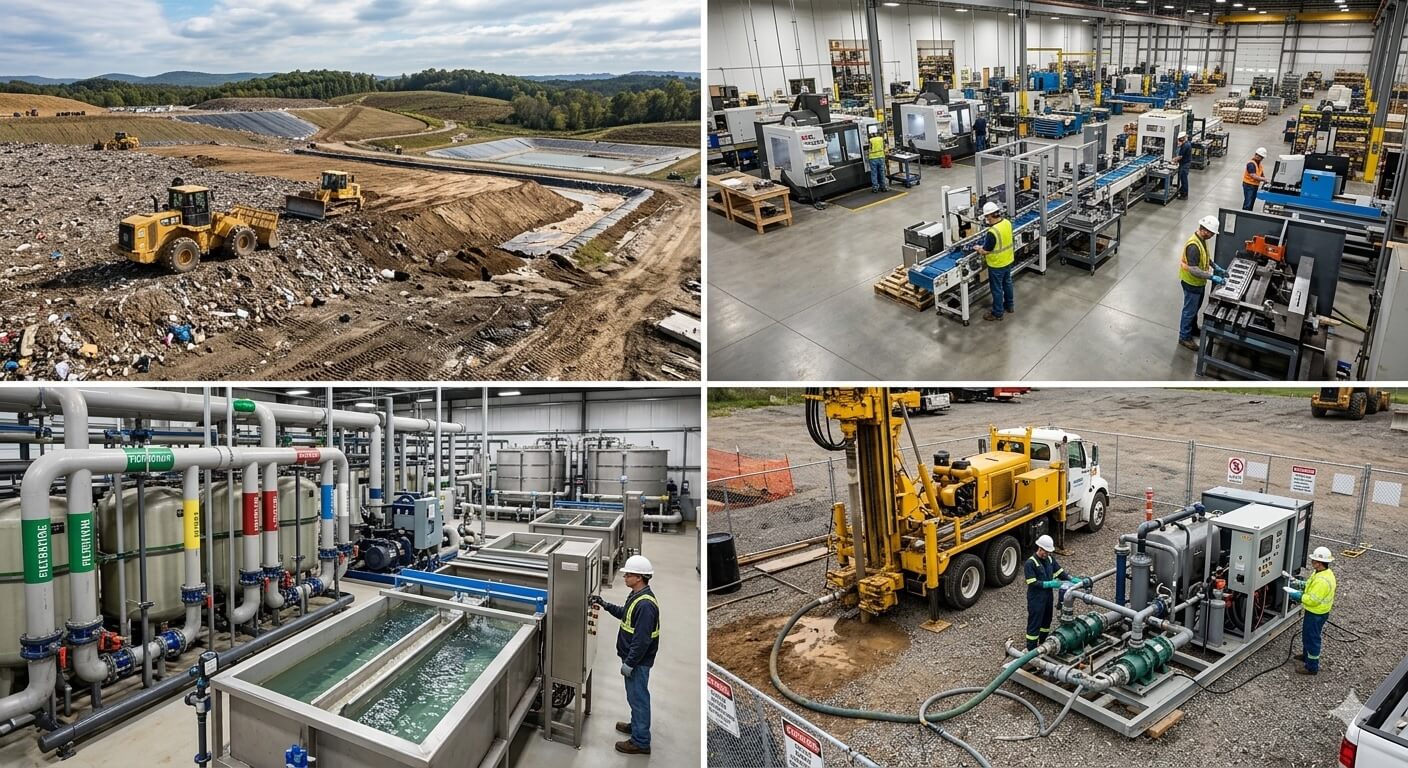
If you're managing aqueous PFAS waste, we can probably help.
Aviation rinse, fire-response training grounds, paper & pulp, electronics recycling, and landfill operations are all high-fit applications. If you're carrying or storing a high concentration PFAS waste stream for disposal, we'd like to hear about your case.
Designed for industrial-scale deployment.
Thermobind is designed to integrate with existing PFAS treatment infrastructure and operational workflows. Modular systems support flexible deployment across remediation and industrial sites, while fixed installations deliver continuous processing at industrial scale.