
Thermobind is creating the PFAS concentration category.
PFAS treatment is being mandated by federal limits, state cleanup rules, and a wave of liability litigation. Capture is being built out. The waste problem behind it (what to do with the concentrate) is wide open. Thermobind owns the disposal-economics layer.
The PFAS market is bifurcating. We sit on the half nobody else has solved.
Reverse osmosis, ion exchange, and Foam Frac (FF) capture PFAS, but they don't destroy or shrink it. They concentrate it into a problem that must be stored, transported, and ultimately destroyed at specialty facilities.
Thermobind reduces that downstream waste volume by over 98% and integrates with existing capture systems. That's a horizontal, attach-rate play across every PFAS treatment site.
The future of PFAS treatment will be defined by whoever owns disposal economics. We're building that company.
A regulated, recurring, multi-sector spend, measured in tens of billions.
PFAS treatment and remediation is being mandated across drinking water, industrial operators, landfill operators, and remediation programs. Capture spend is already being committed.
Disposal, the part of the value chain Thermobind targets, is where the real per-ton economics live, and it grows in lock-step with every capture install going in upstream.
Market values are directional and supported by sourced figures in the data room.
The rules now require what Thermobind already does.
Every layer of PFAS regulation moves the value of disposal-side volume reduction up. The pressure is not slowing.
Federal MCLs in force
EPA has set enforceable drinking-water limits on six PFAS compounds, including ppt-level limits on PFOA and PFOS. Utilities and industrial dischargers are on the clock.
Liability is moving downstream
Multidistrict litigation, state attorney-general actions, and CERCLA designation for PFOA/PFOS turn every site with PFAS waste into a balance-sheet exposure.
50+ state programs
States are layering surface-water, biosolids, and waste-handling rules on top of federal limits, accelerating demand for compact, manifest-ready PFAS waste solids.
Why this becomes a large company.
A novel chemistry, a productized skid system, an attach-rate commercial motion, and an addressable market that grows every time a new capture system goes online. The combination is rare.
Proprietary thermo-responsive polymer
Thermobind polymer binds PFAS at ambient temperature in solution. A 40°C trigger collapses the bound complex into dense, filterable flocs. No high-temperature destruction, no exotic media handling.
Disposal-economics, not yet-another-capture-step
Existing players concentrate. We compact. A bind–flocculate–filter cycle reduces PFAS waste volume by over 98%, turning truckloads of liquid concentrate into compact, transport-ready solids.
Attaches to every PFAS treatment site
We don't displace RO, IX, or FF, we install downstream of them. Every new capture deployment is a Thermobind opportunity, and skid placements generate ongoing polymer and service revenue.
From validated pilots to category leadership.
Pilot
Validating Thermobind polymer and the skid in real industrial and waste-handler streams. Building a reference book of measured volume reductions.
Commercial skid releases
Productize the portable and fixed skid lines. Stand up service operations, polymer supply chain, and the per-pass reporting platform.
Multi-sector roll-out
Landfill, industrial, water-utility, and environmental services channels. Targeted partnerships with established remediation contractors and treatment OEMs.
What we share under NDA.
Pitch deck, polymer test data, skid engineering documentation, go-to-market plan, financial model, customer pipeline, and IP strategy. We move quickly with serious operators and serious capital.
Request NDA access
Tell us a little about your firm, sector, and stage of interest, and we'll send a mutual NDA plus the data-room link within two business days.
If you're managing aqueous PFAS waste, we can probably help.
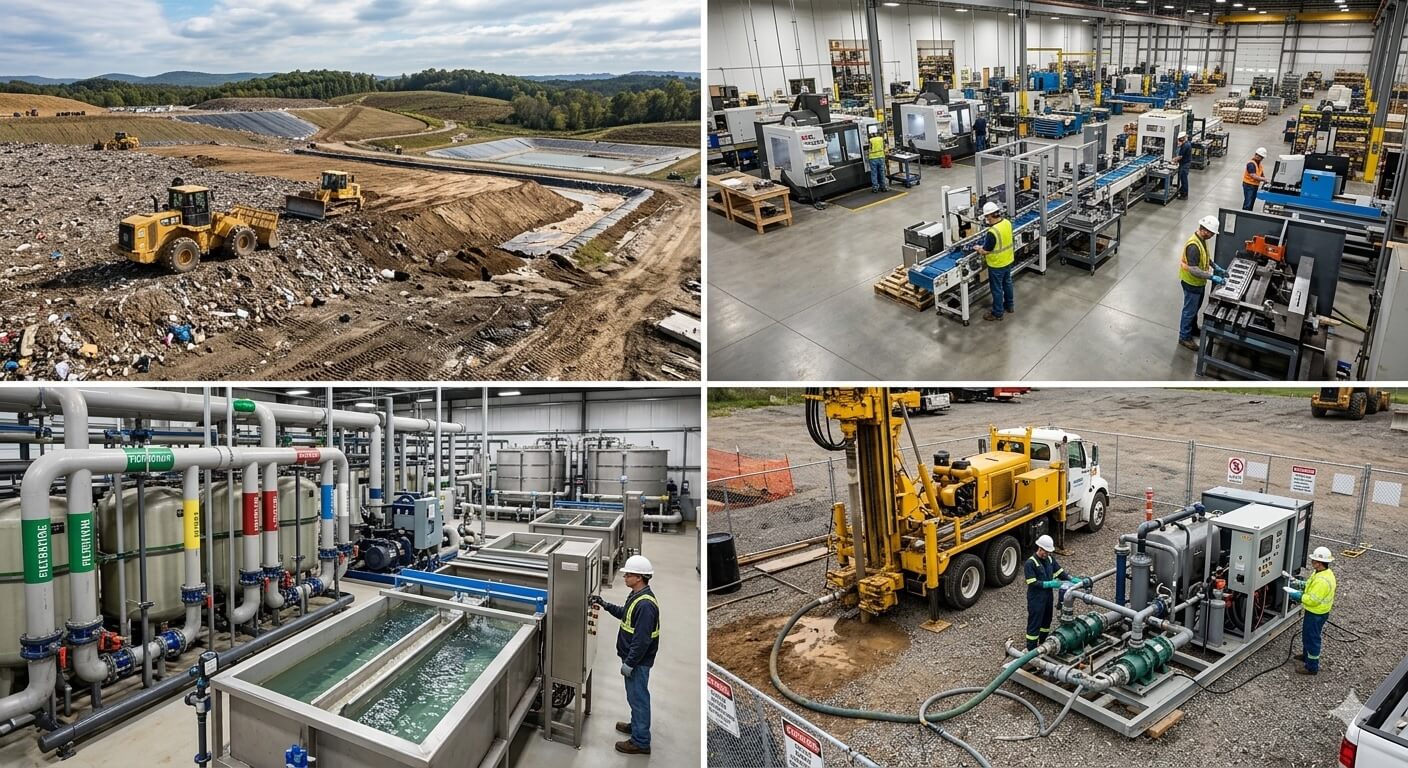
Aviation rinse, fire-response training grounds, paper & pulp, electronics recycling, and landfill operations are all high-fit applications. If you're carrying or storing a high concentration PFAS waste stream for disposal, we'd like to hear about your case.
Build the category with us.
We're prioritizing capital and partnerships that move PFAS off the table, operationally and environmentally.